
Key takeaways
- Co-investment lets an investor in an AIF put additional money directly into a specific unlisted company that the AIF is investing in or has invested in.
- Since September 2025, Category I and II AIFs can offer co-investment through a separate Co-Investment Vehicle (CIV) scheme, in addition to the existing portfolio management (PMS) route.
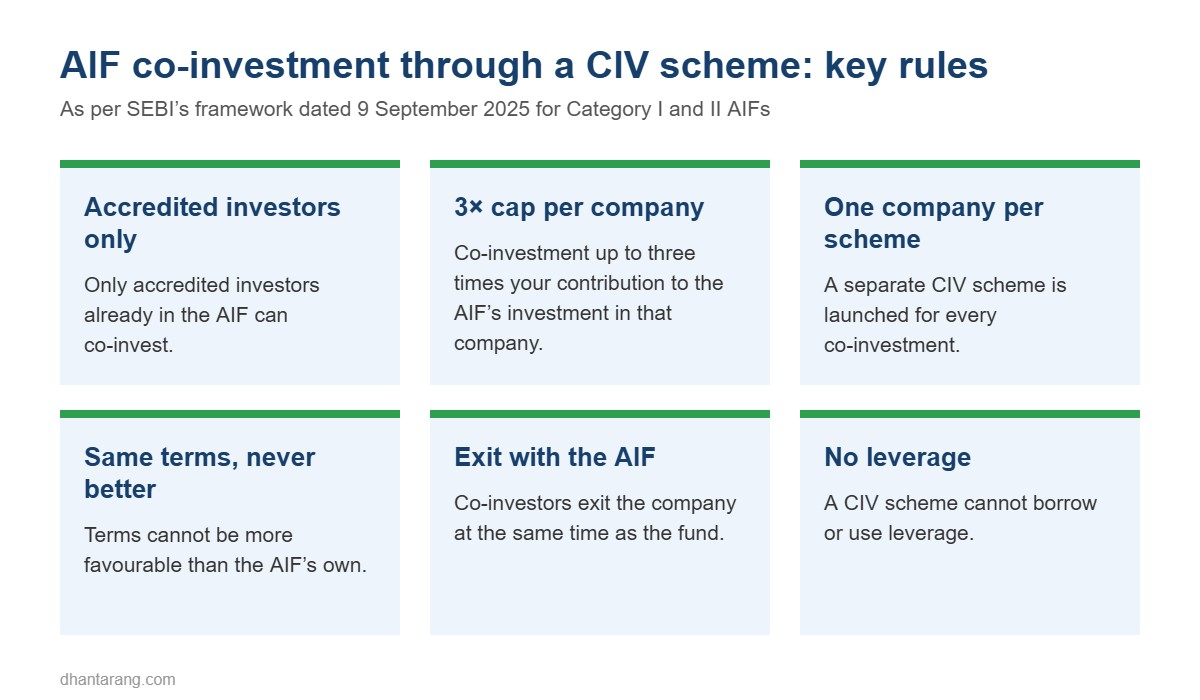
- Only accredited investors of the AIF can invest through a CIV scheme.
- An investor’s co-investment in a company is capped at three times their contribution to the AIF’s investment in that company.
- Co-investors get the same terms as the AIF, never better, and must exit at the same time as the AIF.
Imagine you have invested in a private equity fund, and the fund manager finds a company they believe in strongly. The fund can only put a limited amount into one company, but you would like a bigger stake in that particular deal. Co-investment is how you can do that. Until recently, the route in India was complex. SEBI’s September 2025 framework created a simpler structure inside the AIF regulations themselves. This guide explains how co-investment works, who is allowed to participate, and what rules protect co-investors.
What is co-investment in an AIF?
Co-investment in an AIF means offering the fund’s own investors an opportunity to invest additional money in the unlisted securities of a company where the AIF is also investing or has already invested. The investor holds a larger stake in that one company than their share of the fund alone would give them.
In a normal AIF investment, your money is spread across all the companies the fund backs. In a co-investment, you choose to put extra money into one specific company, alongside the fund, on the same terms. It is common in private equity and venture capital worldwide, especially for large deals where the fund wants to bring in more capital without exceeding its own concentration limits.
Why do investors choose to co-invest?
Investors co-invest to increase exposure to a specific company they have conviction in, while relying on the AIF manager’s research, negotiation and monitoring. The investment is made on the same terms the AIF receives, and the co-investor exits when the fund exits.
- Targeted exposure: a larger position in one company, rather than only a diversified share of the fund.
- Manager-led due diligence: the deal has already been researched and negotiated by the fund manager.
- Aligned terms: co-investors invest on the same terms as the AIF, and SEBI does not allow better terms for co-investors.
- Choice: co-investment is optional and offered deal by deal, so you decide which opportunities to take.
What are the two routes for co-investment in India?
Managers of Category I and II AIFs can offer co-investment through one of two routes: the portfolio management (PMS) route under the SEBI (Portfolio Managers) Regulations, 2020, or the Co-Investment Vehicle (CIV) scheme route introduced in September 2025 under the AIF regulations.
| PMS route | CIV scheme route | |
|---|---|---|
| Regulated under | SEBI (Portfolio Managers) Regulations, 2020 | SEBI (AIF) Regulations, 2012 (Regulation 17A) |
| Introduced | Existing route | September 2025 |
| Manager requirement | Manager must also register as a portfolio manager | Works within the AIF structure |
| Who can invest | As per PMS rules; confirm eligibility with the manager | Only accredited investors of the AIF |
| Structure | Investment managed through a PMS account | Separate scheme for each co-investment, with ring-fenced bank and demat accounts |
The CIV route is generally simpler for managers, because they do not need a separate portfolio manager registration to offer co-investment.
What is a CIV scheme?
A Co-Investment Vehicle (CIV) scheme is a scheme launched by a Category I or Category II AIF to let its investors co-invest in the unlisted securities of a company where the AIF is investing or has invested. Each CIV scheme is created for one investment only and invests in only one company.
Because a CIV scheme is tied to a single deal, a new one must be launched for every co-investment, and it can be wound up once the investment is exited. Each scheme keeps separate bank and demat accounts, so its assets are ring-fenced from the main fund and from other CIV schemes. Angel funds cannot launch CIV schemes.
Who can participate in AIF co-investment?
Under the CIV route, only accredited investors who are already investors in the eligible AIF can co-invest. Investors who have been excused, excluded or have defaulted on their contributions to the AIF cannot co-invest in that company. You cannot join a CIV scheme without first being an investor in the main fund.
An accredited investor is someone certified by a SEBI-recognised accreditation agency as meeting income or net-worth thresholds. The current criteria for resident investors are:
| Route to accreditation | Threshold |
|---|---|
| Individuals, HUFs, family trusts, sole proprietors: income only | Annual income of at least ₹2 crore |
| Individuals and others: net worth only | Net worth of at least ₹7.5 crore, with at least ₹3.75 crore in financial assets |
| Individuals and others: income plus net worth | Annual income of at least ₹1 crore and net worth of at least ₹5 crore, with at least ₹2.5 crore in financial assets |
| Body corporates | Net worth of at least ₹50 crore |
The value of your primary residence is not counted in net worth. Note that SEBI issued a consultation paper on 13 August 2026 proposing changes to the accredited investor framework, including manager-led accreditation and a new securities-assets route. These are proposals only, and the criteria above apply until SEBI notifies any change.
How much can you co-invest?
Your co-investment in a company, across all CIV schemes, cannot exceed three times the amount you contributed through the main AIF scheme towards the AIF’s investment in that same company. This cap does not apply to certain institutional investors, such as sovereign wealth funds, development financial institutions and government-owned entities.
An illustration: suppose the AIF invests ₹20 crore in Company X, and your share of the fund means ₹40 lakh of that came from your contribution. Your maximum co-investment in Company X through CIV schemes would be three times ₹40 lakh, or ₹1.2 crore. (Illustrative figures only.)
What rules protect co-investors?
SEBI’s framework sets conditions to keep co-investment fair to both co-investors and the AIF’s other investors:
- Same terms, never better: co-investment terms cannot be more favourable than the AIF’s own terms in that company.
- Exit together: co-investors must exit the company at the same time as the AIF.
- No leverage: a CIV scheme cannot borrow or use leverage.
- Pro-rata rights: investors in a CIV scheme get pro-rata rights and pro-rata distribution of proceeds.
- Fair cost sharing: expenses of the co-investment are shared between the AIF scheme and the CIV scheme in proportion to their investments.
- Full disclosure: before offering any co-investment, the manager must file a Shelf Placement Memorandum with SEBI through a merchant banker, disclosing the principal terms, allocation method, expenses, conflicts of interest and governance structure.
- No regulatory shortcuts: a CIV scheme cannot be used to make investments an investor could not make directly, or to avoid disclosures that a direct investment would trigger.
- Oversight: the manager reports compliance to the trustee and sponsor in the annual compliance test report.
SEBI’s Master Circular for AIFs dated 3 June 2026 consolidates these instructions in one place.
How does co-investment work, step by step?
- Invest in the AIF. You first become an investor in a Category I or II AIF that offers co-investment.
- Get accredited. Obtain an accreditation certificate from a SEBI-recognised accreditation agency, if you do not already hold one.
- Receive the opportunity. When the fund invests in a company and offers co-investment, the manager shares the terms under the Shelf Placement Memorandum.
- Decide and commit. You choose whether to participate and how much, within the three-times cap.
- Invest through the CIV scheme. A separate CIV scheme is launched for that company, with its own accounts.
- Exit with the fund. When the AIF exits the company, the CIV scheme exits too, and proceeds are distributed pro-rata.
What are the risks of co-investment?
Co-investment concentrates your money in a single unlisted company, so it carries more risk than your diversified AIF holding. If that one company performs poorly, there are no other holdings in the CIV scheme to balance the loss.
- Concentration risk: a CIV scheme holds only one company.
- Liquidity risk: you can exit only when the AIF exits, which may take several years.
- Valuation risk: unlisted companies are valued periodically, not daily.
- Allocation and conflict risk: check how the manager decides who gets co-investment opportunities and how much, as disclosed in the Shelf Placement Memorandum.
- Overexposure: co-investing in a company you already hold through the AIF increases your total exposure to that one business.
Questions to ask before you co-invest
- Is the co-investment through the PMS route or a CIV scheme?
- What is my existing exposure to this company through the main fund, and what would my total be?
- How are co-investment opportunities allocated among investors?
- What expenses and fees apply to the CIV scheme, and how are they shared with the main fund?
- What is the expected holding period, and when is the AIF likely to exit?
- How will returns from the co-investment be taxed in my hands? Confirm with your tax adviser.
Frequently asked questions
What is co-investment in an AIF?
Co-investment is an opportunity for an AIF’s investors to put additional money directly into a specific unlisted company that the AIF is investing in or has invested in, on the same terms as the AIF.
Who can co-invest through a CIV scheme?
Only accredited investors who are already investors in the eligible Category I or II AIF. Investors who have been excused, excluded or have defaulted on their contributions cannot co-invest in that company.
When did SEBI introduce CIV schemes?
SEBI notified the AIF (Second Amendment) Regulations, 2025 on 8 September 2025 and issued the operational framework through its circular dated 9 September 2025.
Is there a limit on how much I can co-invest?
Yes. Your co-investment in a company across all CIV schemes cannot exceed three times your contribution to the AIF’s investment in that company. The cap does not apply to certain institutional investors, such as sovereign wealth funds.
Can a CIV scheme invest in more than one company?
No. Each CIV scheme is investment-specific and invests in only one company. A separate CIV scheme is launched for every co-investment.
Can co-investors exit earlier than the AIF?
No. Co-investors must exit the company at the same time as the AIF, so the co-investment follows the fund’s exit timeline.
Co-investment: more conviction, more concentration
Co-investment gives accredited AIF investors a regulated way to back the deals they believe in most, on the same terms as the fund. It also concentrates risk in a single unlisted company, so it suits investors who already have a diversified portfolio and can stay invested until the fund exits.
DhanTarang Fintech Pvt Ltd, based in Mumbai, helps investors understand alternative investments and how they fit alongside mutual funds and PMS. Learn about Alternative Investment Funds or talk to our team.
Sources
- SEBI circular: Framework for AIFs to make co-investment within the AIF structure (9 September 2025)
- Saraf and Partners: SEBI frameworks for Angel Funds and Co-Investment Vehicles
- AZB & Partners: SEBI Co-Investment Scheme Framework
- Cyril Amarchand Mangaldas: SEBI unlocks co-investment schemes for AIFs
- Outlook Business: SEBI gives flexibility to AIFs to offer co-investment
- Upstox: SEBI’s rules for accreditation of investors
- CorpLawUpdates: SEBI consultation on the Accredited Investor framework (2026)
- SEBI: AIF circulars and Master Circular (3 June 2026)
Disclaimer: This article is for general information and education only. It is not an offer, solicitation or recommendation to invest in any Alternative Investment Fund. AIFs are offered only through private placement to eligible investors on the basis of a Private Placement Memorandum (PPM), which should be read carefully along with all scheme documents. AIF investments carry market, liquidity and credit risks, and past performance is not indicative of future returns. Tax treatment is subject to change; consult a tax adviser. DhanTarang Fintech Pvt Ltd is an AMFI-registered Mutual Fund Distributor, ARN-343986.