
Key takeaways
- Life Cycle Funds are a new mutual fund category introduced by SEBI on 26 February 2026 for goal-based investing.
- Each fund has a fixed maturity of 5, 10, 15, 20, 25 or 30 years, and the maturity year is part of its name.
- The fund automatically shifts from equity towards debt as maturity approaches, following a glide path set by SEBI.
- Early exits are discouraged with an exit load of 3%, 2% and 1% in the first three years, and nil after that.
- They suit goals with a fixed date, such as retirement or a child’s higher education.
Most investors know they should reduce risk as a goal gets closer, but very few actually do it. Equity that should have been moved to safer assets two years before a child’s college admission often stays in the market, and a single bad year can hit exactly when the money is needed. Life Cycle Funds are SEBI’s answer to this problem. This guide explains how they work, who they suit, and what to check before you invest.
What is a Life Cycle Fund?
A Life Cycle Fund is an open-ended mutual fund with a fixed target maturity year, such as 2036 or 2056. It invests heavily in equity when the goal is far away and gradually shifts to debt as the maturity year approaches. This automatic change in asset mix is called a glide path, and SEBI prescribes its limits.
Around the world, the same idea is known as a target-date fund and is widely used for retirement savings. In India, SEBI introduced it as a formal category through its circular of 26 February 2026 on the categorisation and rationalisation of mutual fund schemes. The first Life Cycle Funds were launched in June 2026, and more fund houses have since followed with new fund offers.
How does a Life Cycle Fund work?
You pick the fund whose maturity year matches your goal and keep investing through a SIP or lump sum. The fund manager reduces equity and increases debt as the years pass, staying within SEBI’s bands for each stage. You do not need to switch funds or rebalance yourself.
SEBI’s framework sets the allocation range according to the years left to maturity:
| Years to maturity | Equity | Debt | Gold/silver ETFs, ETCDs, InvITs |
|---|---|---|---|
| 15–30 years | 65–95% | 5–25% | 0–10% |
| 10–15 years | 65–80% | 5–25% | 0–10% |
| 5–10 years | 50–65% | 5–25% | 0–10% |
| 3–5 years | 35–50% | 25–50% | 0–10% |
| 1–3 years | 20–35% | 25–65% | 0–10% |
| Less than 1 year | 5–20% | 25–65% | 0–10% |
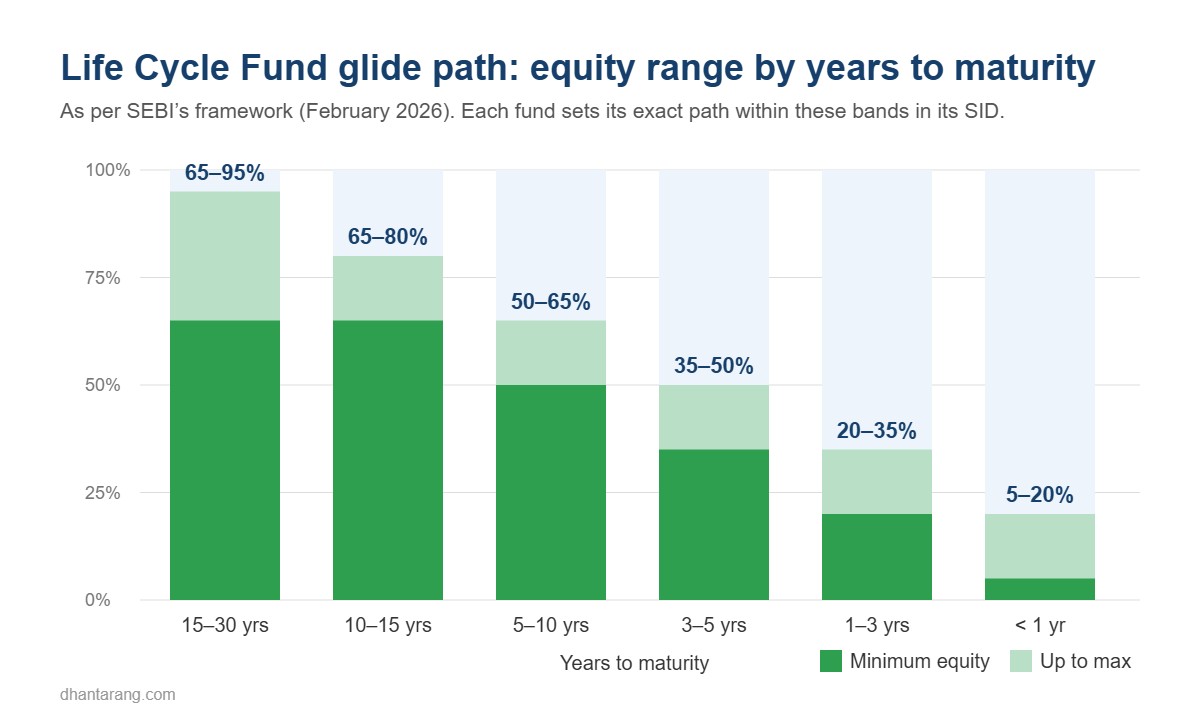
Debt investments in these funds are limited to instruments rated AA and above. Within these bands, each fund house sets its own exact glide path in the Scheme Information Document (SID), so two funds with the same maturity year can still differ.
What are the key rules for Life Cycle Funds?
SEBI has standardised the structure of this category so investors can compare funds easily:
- Fixed maturities: 5, 10, 15, 20, 25 or 30 years.
- Maturity year in the name: for example, a fund maturing in 2046 must carry “2046” in its name.
- Open-ended: you can invest and redeem at any time, subject to exit load.
- Limited number: each fund house can have a maximum of six active Life Cycle Funds at a time, and fewer if it continues its retirement or children’s funds.
- Multi-asset investing: besides equity and debt, the funds can hold gold and silver ETFs, ETCDs and InvITs within limits.
- Mandatory exit load: 3% if redeemed within one year, 2% within two years, 1% within three years, and nil after three years.
The exit load is deliberate. These funds are built for long goals, and the charge nudges investors to stay the course rather than react to short-term market moves.
How are Life Cycle Funds different from retirement and children’s funds?
Retirement and children’s funds were labelled by purpose, but their portfolios did not have to change as the goal came closer. Life Cycle Funds are built around a maturity year, and their asset mix must follow SEBI’s glide path. SEBI first discontinued the old solution-oriented category in February 2026, then in March 2026 allowed fund houses to continue these funds with conditions.
| Feature | Life Cycle Fund | Retirement / children’s fund | Balanced advantage fund |
|---|---|---|---|
| Fixed maturity year | Yes, 5 to 30 years | No | No |
| Asset mix changes with time | Yes, by SEBI glide path | Not required | Changes with market valuation |
| Maturity year in name | Yes | No | No |
| Exit load | 3% / 2% / 1% in first three years | Scheme-specific; many had a 5-year lock-in | Scheme-specific |
| Status in 2026 | New category | May continue, at the fund house’s choice | Continues |
A fund house that continues its children’s fund cannot launch a 20-year Life Cycle Fund, and one that continues its retirement fund cannot launch a 30-year Life Cycle Fund. If you already hold a retirement or children’s fund, wait for your fund house’s communication on whether the scheme continues before deciding what to do with it.
Who should invest in a Life Cycle Fund?
Life Cycle Funds suit investors saving for one specific goal with a clear date, who want risk to reduce automatically as that date approaches. They work best for people who prefer a hands-off approach and are willing to stay invested for at least three years.
They may suit you if:
- you are saving for retirement and know roughly the year you plan to stop working;
- you are building a fund for your child’s higher education or marriage with a known timeline;
- you tend to forget or delay rebalancing between equity and debt.
They may not suit you if your goal date is uncertain, you may need the money within three years, or you prefer to manage your own asset allocation across several funds.
How are Life Cycle Funds taxed?
Life Cycle Funds are taxed like other mutual funds, and you pay tax only when you redeem. The shift from equity to debt inside the fund does not create tax for you, because rebalancing happens within the scheme. Whether gains are taxed as equity or as debt depends on how much equity the fund holds, which is stated in its SID.
Some funds are designed to stay equity-oriented through their life, while others may not be in the final years when equity falls sharply. Check the tax treatment in the SID before you invest, especially for shorter-maturity funds.
What should you check before choosing a Life Cycle Fund?
- Match the maturity year to your goal. Choose the fund maturing closest to the year you will need the money.
- Read the glide path in the SID. It shows exactly how equity will reduce each year within SEBI’s bands.
- Compare costs. Look at the Base Expense Ratio (BER) and total expense ratio of funds with similar maturities.
- Understand the tax treatment stated in the SID for the fund’s later years.
- Plan for the exit load. Invest only money you will not need in the first three years.
- Keep one fund per goal. A separate Life Cycle Fund for each goal keeps planning clear.
To estimate how much you need to invest every month for a goal, use our SIP calculator.
Frequently asked questions
What is a Life Cycle Fund in simple words?
A Life Cycle Fund is a mutual fund linked to a goal year. It invests more in equity when your goal is far away and automatically moves money into debt as the goal approaches, so you do not have to rebalance yourself.
When did SEBI introduce Life Cycle Funds?
SEBI introduced Life Cycle Funds through its circular dated 26 February 2026 on the categorisation and rationalisation of mutual fund schemes. The first funds in this category were launched in June 2026.
What maturities do Life Cycle Funds have?
Life Cycle Funds can have maturities of 5, 10, 15, 20, 25 or 30 years. The maturity year must appear in the fund’s name, for example “Life Cycle Fund 2046”.
Can I withdraw money from a Life Cycle Fund before maturity?
Yes. Life Cycle Funds are open-ended, so you can redeem at any time. An exit load of 3% applies within one year, 2% within two years and 1% within three years. There is no exit load after three years.
Can I start a SIP in a Life Cycle Fund?
As open-ended schemes, Life Cycle Funds generally accept SIPs after the new fund offer period. The minimum SIP amount and dates depend on the individual scheme.
Are Life Cycle Funds safe?
All mutual funds are subject to market risk. Life Cycle Funds reduce equity risk as maturity approaches, but they can still lose value, especially in the early years when equity can be as high as 95% of the portfolio.
Plan your goals with a fund that plans ahead
Life Cycle Funds bring discipline to goal-based investing: one fund, one goal, one date, with risk reduced automatically along the way. For investors who know when they will need their money, they are a simple and structured option worth considering.
DhanTarang Fintech Pvt Ltd is an AMFI-registered Mutual Fund Distributor (MFD) based in Mumbai. We help you match your goals with the right Life Cycle Fund, compare glide paths and costs, and start a SIP. Explore our mutual fund services or talk to our team.
Disclaimer: Mutual Fund investments are subject to market risks, read all scheme related documents carefully. Past performance is not indicative of future returns. This article is for general information only and is not investment advice. Scheme features vary; read the Scheme Information Document before investing. DhanTarang Fintech Pvt Ltd is an AMFI-registered Mutual Fund Distributor, ARN-343986.